![[personal profile]](https://www.dreamwidth.org/img/silk/identity/user.png) ellarien
ellarienThe next stop was a jade factory, where we were given a brief tour past workers in glass case, working on jade carvings with water-cooled drills, followed by a quick lecture on spotting genuine jade. Then we were turned loose in the showroom. A young lady kept following me around, right behind me at a distance slightly shorter than most Americans would find comfortable, telling me what things were (as if it wasn't obvious!) Eventually I bought a small cup for $50 to get rid of her. There were some lovely sculptural pieces around the showroom, though -- horses, dragon ships, buddhas, trees, lions. Some of the bigger pieces cost about the price of a good American car.
After that we got back in the bus and went to a Friendship Store and restaurant for lunch. The store was a huge space, crowded at market-stall densities with everything from silk clothing to porcelain, paintings to christmas ornaments. (The day before, I'd tried to ask the young lady at the hotel gift store if there was some Chinese cultural use for Christmas ornaments, but she didn't seem to think so.) One man was doing amazing finger-paintings in black ink, claiming it was a skill known only in his family.
Back in the bus again on the way to the Wall, we passed a half-built, abandoned theme park, disney-style, with turrets in front and the grey concrete skeleton of a fairy-tale castle in the distance. According to our guide, it turned out not to be a sensible site, because people on the way to the Wall or the Tombs don't have time for a theme park as well. I wondered whether Disney would have been in a position to demand royalties, if it wasn't an actual Disney project.
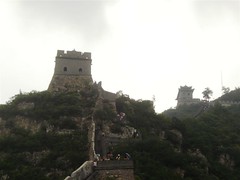
Finally, after the road got in among the mountains, we reached the Great Wall, at Juyongyuan Pass. There's a fort in the pass, and wall snaking up both sides of the valley. It's a staircase, basically, very steep and uneven in places, hard going even with the handrail -- the soldiers must have been fit. Building it cost the lives of 20% of the workforce, mostly from exhaustion and malnutrition trying to work in the winter cold on a diet of rice. Wolf dung was used for signals in the daytime, as it made a nice thick black smoke.
The mountains were rugged but green, and mostly vanishing into the haze; it was warm and sticky.
There's a sign, 'Speaking cellphone is strictly prohibited when thunderstorm,' and a cellphone relay station on one of the free-standing fort buildings nearby. (It wasn't thundertorm, and I overheard a French lady on her phone. "Hello, it's me, I'm in China. I'm sitting on the Great Wall and the cellphone works perfectly!" I made it three towers up (about halfway to the top of the hill) and climbed to the roof of the first one (very steep narrow stairs with no handrail) before I decided I needed to save the rest of my energy for getting back down. I decided the effort merited a personalized brass plaque, anyway.
There were padlocks attached to chains festooned along the bridge at the bottom of the climb, with names and dates scratched on, often adorned with bits of red ribbon or yarn. Some kind of good-luck custom?
I'd really have liked to spend more time exploring the settlement/fort in the valley as well as slogging up the wall, but after the allowed hour and a half we straggled back to the bus and headed back into Beijing's afternoon rush-hour.
I think I'll just link to the Flickr set, this time, but here's one picture to whet your appetite.